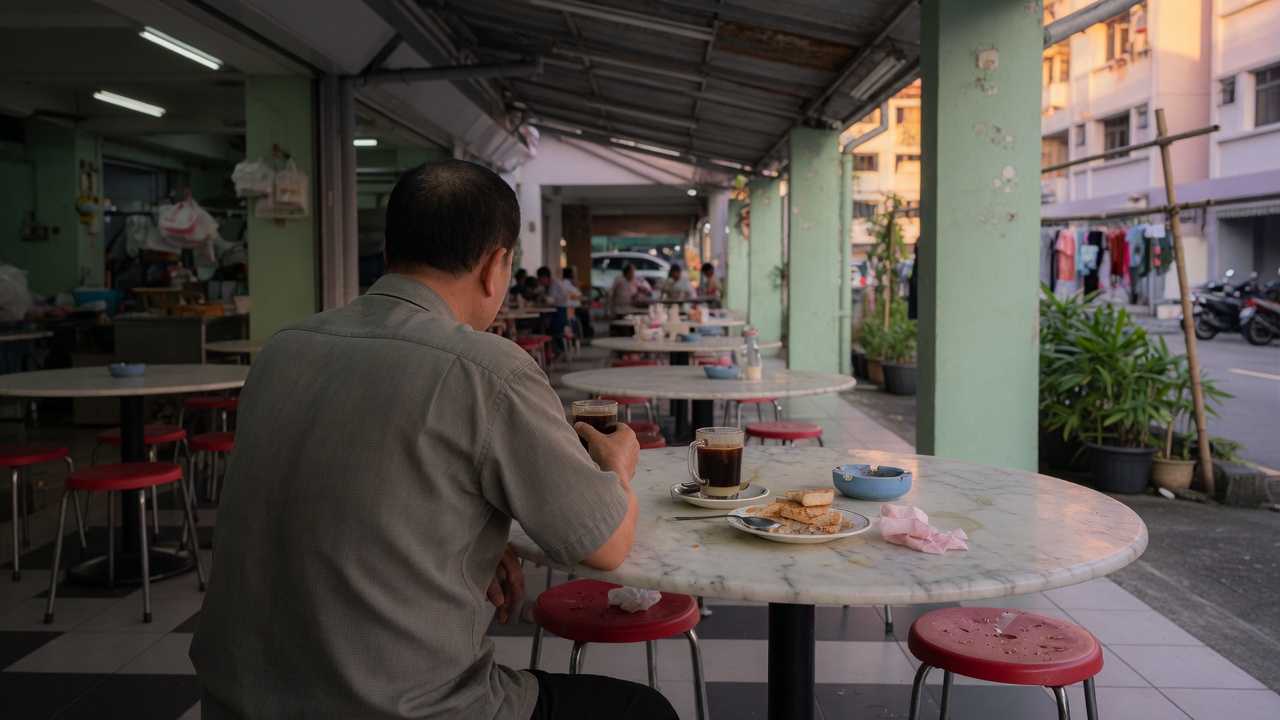
“Most men don’t say “I feel lonely.” They just work more. Sleep less. Laugh when they’re hurting. Disappear a little more each day. And no one notices. Because no one asks.”
Male loneliness in Singapore is increasingly described as a social problem, but it should also be understood as a psychological one. The issue is not simply that more men are alone; the issue is that many men feel unseen and unwitnessed even when they remain surrounded by partners, colleagues, friends, or family. Indeed, male loneliness rarely appears only as physical isolation and more often emerges as numbness, irritability, emotional distance, or a quiet sense of moving through life without feeling deeply known. This distinction deserves attention because loneliness is often misread. Men who appear functional, productive, and socially connected may still experience profound disconnection if they do not feel safe being emotionally honest within those relationships. For instance, a man may continue to meet family obligations, perform at work, and maintain social contact, while privately feeling that none of those relationships can hold his full internal experience.
Moreover, recent research suggests that loneliness is becoming more salient among men in Singapore, especially among younger adults. A recent survey by the Institute of Policy Studies suggests higher levels of social isolation and lower companionship among adults aged 21 to 34, with nearly 69% of suicide deaths in Singapore were among men in 2023. Suicide is always multi-determined, so this statistic should not be reduced to loneliness alone. Nevertheless, the imbalance points to the heavier burden many men appear to carry quietly and with limited emotional disclosure. This pattern is psychologically significant because it suggests that male distress is often under-expressed rather than absent. Men may not always articulate loneliness in direct language, yet they often describe parallel experiences such as emotional exhaustion, disconnection, or the sense that they cannot truly speak to anyone. For example, a man may say that he has a wife, children, colleagues, or friends, yet still feel that none of those relationships allow him to speak honestly without self-monitoring. That pattern indicates not mere social scarcity, but emotional non-recognition.
The sociocultural context
Over recent decades, women’s roles have expanded across education, work, finances, and family life, and these changes have been both necessary and overdue. However, the transition for men has often been less clear, because older expectations have not disappeared while newer ones have been added. Men are still expected to be stable, competent, and productive, yet they are now also expected to be emotionally expressive, relationally attuned, and psychologically fluent. This shift, among other stressors, creates strain because the emotional rules often remain unclear even when the social roles have changed. Men may be told to open up more, but many still sense that there are limits to how much vulnerability is acceptable before they are judged, burdening others, or appearing weak. For example, a man may understand intellectually that he should be more communicative, yet still feel that anger is easier to express than fear, and that competence is safer to display than confusion. The consequence is not simply reluctance to connect, but uncertainty about how connection can occur without cost. Furthermore, many traditional responsibilities remain intact even as emotional demands increase. Men are still widely expected to succeed professionally, remain financially stable, and appear emotionally steady. At the same time, they are now expected to contribute more psychologically at home, to be present partners, and to function as engaged fathers. Many men are therefore trying to hold older burdens and newer expectations simultaneously.
This dual demand often generates self-judgment. When men struggle under competing expectations, they may interpret that struggle as a personal inadequacy instead of as a predictable response to role overload. For instance, a man who feels tired, emotionally flattened, or less available than he believes he should be may not conclude that his load is excessive; he may instead conclude that he is failing. Once that interpretation takes hold, withdrawal becomes more likely, and support becomes even harder to seek. These problems are further propagated by social media reshaping how men evaluate themselves. Daily exposure to idealised images of success, fitness, confidence, and family life creates a constant background of comparison. These portrayals are selective, but they remain psychologically persuasive because they repeatedly present the appearance of effortless functioning.
The psychological consequence is that many men begin comparing private struggle to public performance. A man who feels insecure, exhausted, or emotionally lost may then assume that other men are coping more effectively than he is, simply because their struggles are less visible. For example, when online life repeatedly presents competence without confusion, many men conclude not that the image is partial, but that their own difficulty is evidence of personal deficiency. To these men, withdrawal becomes second nature. In practice, loneliness may manifest as detachment rather than sadness. A man may become more irritable at home, flatter in affect, more emotionally avoidant, or more immersed in work and routine because those states feel easier to maintain than emotionally exposing himself. For example, a man may not say “I feel lonely,” but he may describe feeling tired of holding everything together, unsure where he belongs, or unable to talk honestly to anyone around him. Those descriptions point to the same underlying condition: disconnection without adequate emotional language.
Support systems
This is a deeply rooted, multifaceted problem that requires time to overcome. Men who feel lonely often do not need to be pushed into instant vulnerability. Rather, having conditions in which emotional honesty becomes safer, less performative, and less likely to be judged can be prioritised to gradually cultivate a mindset and system that accepts displays of vulnerability and imperfection. Even small moments of shared interest, mutual respect, and opportunities to feel genuinely heard can create a world of difference for men attempting to learn how to be more emotionally open. For example, a man may not initially respond well to direct pressure to “open up more,” yet may begin softening once he experiences a relationship in which he is not being appraised, fixed, or hurried. In that sense, support works best when it creates emotional safety before it demands emotional exposure.
Conclusion
Male loneliness in Singapore should not be reduced to a passing social trend or a simple failure to socialise more. The deeper issue concerns emotional disconnection under conditions of changing roles, unclear expectations, persistent masculine pressures, and constant comparison. Many men are not alone in the literal sense; they are alone in the more difficult sense of not feeling met. The more constructive response is therefore not to shame men for withdrawing or to idealise vulnerability in the abstract. A better response is to recognise the strain clearly, create conditions in which honesty feels safer, and understand that reconnection often begins quietly.